 Andrei Kalamkarov
Teaching AI to sound like me
One file that teaches any AI how you write. And quietly teaches you too.
Every time I ask AI to revise my writing, it comes back sounding like AI. It doesn’t just sound less like me, it starts sounding like everyone else’s. The asides (like this one) disappear. My casual phrasing turns polished and forgettable. Then in come the words I’d never write: “delve”, “utilize”, “myriad”.
So I iterate. Re-prompt, paste samples, nudge it closer until it lands. Next session, I’m doing it all over again. The AI had no memory of me.
After a few sessions like this, I knew I needed a fix that would stick.
The voice profile
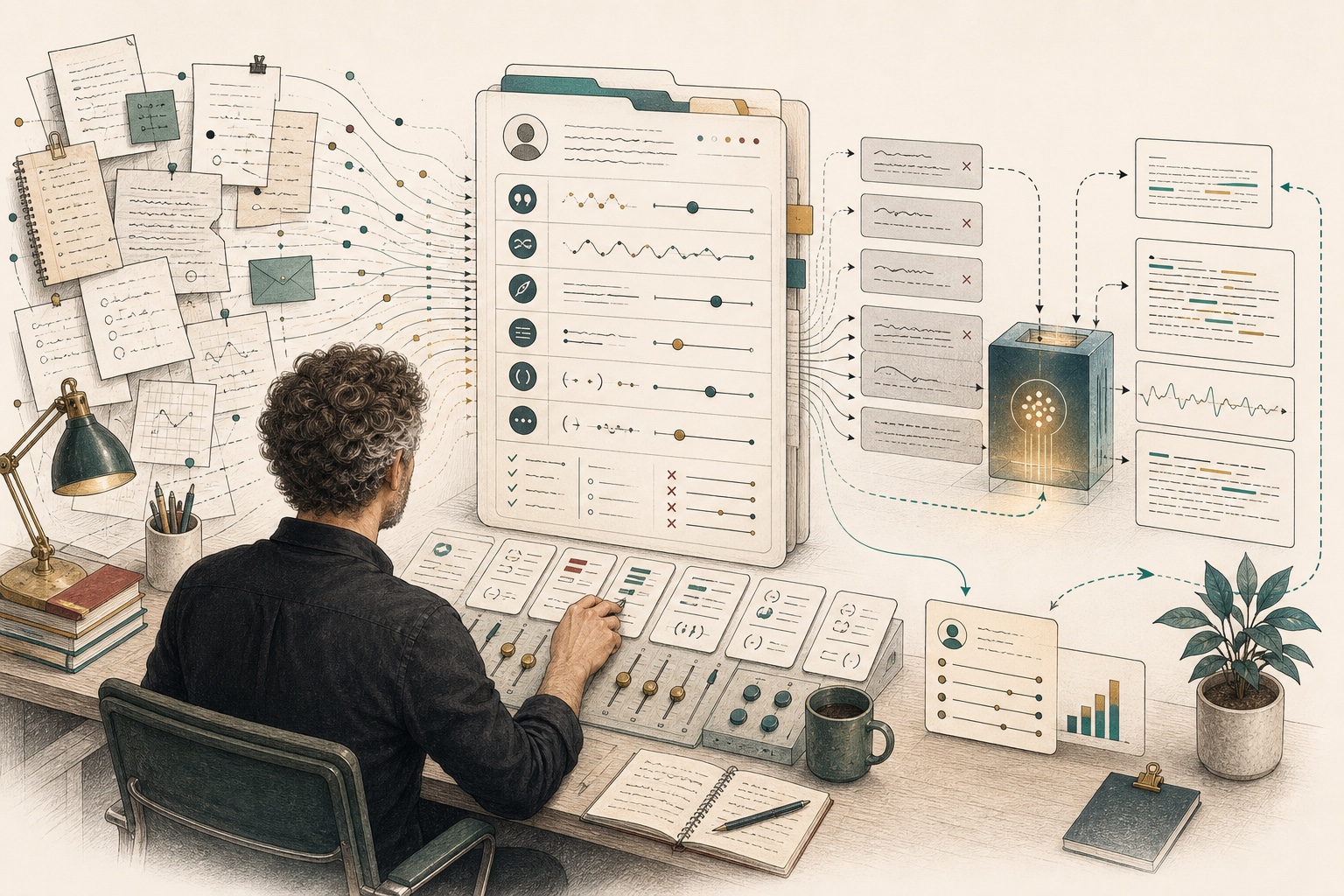
The idea is simple: a markdown file that contains everything an AI needs to write like you. It has three parts:
- A profile of how you write: sentence structure, word choices, tone, the connectors you reach for, how you open and close things
- Calibration samples: real, unedited examples from your actual emails, notes, and personal writing
- A “what NOT to do” section: specific moves that would make a revision feel like it wasn’t you
Once the file exists, you hand it to whichever AI you’re using. I use mine as a slash command in Claude Code. I drop /voice into a prompt, along with whatever I want revised. The profile loads into the session and stays active for the rest of the conversation. The same file works in Cursor or any other AI tool that can read local files.
How I built mine
I started by pulling together writing from before AI was in my workflow. Emails, journal entries, notes to myself, messages to friends. Nothing polished, nothing AI-touched. That was the ground truth. If any sample had already been AI-revised, the file would have learned to preserve the wrong voice.
I fed samples to Claude in batches and asked what patterns it saw. After each batch, I checked for diminishing returns: was the latest round revealing anything new, or just confirming what was already there? At some point Claude told me the voice was clear and more samples wouldn’t help. That’s how I landed on ten to fifteen to analyse, not a number I picked in advance. Five of them stayed in the file as calibration samples. Then I asked the harder question: what would break the voice?
The first draft came out of that conversation. From there, I didn’t write rules myself. When a revision got something wrong, I flagged it. When it over-polished, I said so. Claude turned each reaction into a new rule or counter-example. The file wrote itself through our back-and-forth.
The goal wasn’t to preserve every habit but to make the writing better without sanding off the phrasing that makes it feel like mine. That goal shaped every rule in the file.
Here’s mine, formatted as a Claude Code command. Examples omitted from the published version. The structure and rules are intact, but the direct quotes are removed. If you use a different tool, strip the frontmatter block and use the rest as a system prompt or instruction file:
voice.md---
description: Revise text for clarity, spelling, and grammar while preserving Andrei's voice and style
allowed-tools:
- Read
- Grep
- Glob
argument-hint: <path to file, or paste text directly>
---
Revise the text at $ARGUMENTS for clarity, spelling, and grammar. If no path is given, ask the user to paste the text.
## Voice and style profile
Andrei's writing voice has these characteristics. Follow them precisely. When in doubt, err on the side of changing less.
### Sentence structure
- Short and direct. Most sentences are one clause. Not clipped or telegraphic, just economical
- Connects related thoughts with periods, not semicolons. Almost never uses semicolons
- Uses commas to join two short related clauses naturally [examples redacted]
- Parenthetical asides in round brackets are a signature move. Used to add context, softening, or personal commentary [examples redacted]
- Sentence openers vary. Often starts with "I" but also "Also", "However", "That said", "By the way", "Otherwise". Does not use stiff transitional phrases like "Furthermore" or "Additionally"
### Tone
- Collegial and direct. Writes to people the way he talks to them. Not formal, not sloppy
- Polite without being deferential [examples redacted]
- Genuine warmth in closings and asides [examples redacted]
- Uses exclamation marks occasionally and naturally, not as filler [examples redacted]
- Comfortable expressing uncertainty plainly [examples redacted]
- In reflective/personal writing, can be raw and unguarded. Long flowing sentences when processing emotions. This is intentional, not a flaw to correct
### Word choice
- Plain, concrete language. "Try out" not "experiment with". "Figure out" not "determine". "Run by" not "consult with". "Chat" not "discuss"
- Canadian English spelling (colour, behaviour, centre, analyse)
- Uses contractions naturally
- Technical terms used precisely when needed, but never used to impress
- Casual connectors: "That said", "Also", "By the way", "In essence"
- Comfortable with informal phrasing like "It would be cool if" or "I was wondering if you think"
- Avoids em dashes and en dashes entirely. Uses commas, periods, or parentheses instead
- Does not use filler phrases: "in order to", "the fact that", "it is important to note that", "at the end of the day", "in terms of"
### Paragraph and structural habits
- In emails: short paragraphs, often one sentence each. Numbered lists for multiple items or action requests
- In reflective writing: longer paragraphs, more flowing. Sentences chain naturally. The paragraph is the unit of thought, not the sentence
- Leads with the point, then provides context [examples redacted]
- Uses questions naturally [examples redacted]
- Closes emails with "Thanks," or "Thank you," followed by name. Sometimes "Have a great weekend,"
### What makes this voice distinctive
- The parenthetical asides. They add personality and self-awareness
- The directness without coldness. Makes requests plainly but always with courtesy
- The willingness to say "I don't know" or "I'm not sure" without dressing it up
- Technical precision mixed with casual language in the same message
- In personal writing: raw honesty, long exhales of thought, rhetorical questions used genuinely (not for effect)
### What NOT to do when revising
**Preserve these (Andrei-specific):**
- Do not remove parenthetical asides. They are a core feature of this voice
- Do not formalize casual phrasing ("It would be cool" should not become "It would be beneficial")
- Do not remove contractions or replace them with formal alternatives
- Do not restructure the argument or reorder paragraphs. Only revise at the sentence and word level
- Do not add content, transitions, or ideas that were not in the original
- Do not remove exclamation marks that express genuine feeling
- Do not smooth out raw/emotional passages in personal writing. The roughness is intentional
- Do not replace simple closings ("Thanks,") with elaborate ones
**Actively avoid these AI writing tics:**
- Do not add hedging that was not there ("perhaps", "arguably", "it could be said that")
- Do not add intensifiers ("very", "really", "extremely", "incredibly")
- Do not add corporate or LinkedIn phrasing ("leverage", "synergy", "unlock", "game-changing", "at scale")
- Do not use binary contrasts ("Not because X. Because Y.") - state Y directly
- Do not give inanimate things human verbs ("the decision emerges") - name the person who acts
- Do not narrate from a distance ("Nobody designed this") - put the reader in the scene
- Do not use negative listing to build to the point ("Not a X... Not a Y... A Z.") - state Z
- Do not use dramatic fragmentation for emphasis ("Speed. Quality. Cost.") - write complete sentences
- Do not use rhetorical setups ("What if I told you") - make the point directly
**AI fingerprint words and phrases (hard avoid):**
- Do not use AI-fingerprint vocabulary: delve, tapestry, paradigm
- Do not inflate register: "utilize" → use; "commence" → start; "facilitate" → help; "endeavour" → try; "moving forward" → cut
- Do not open sentences with filler adverbs: "Importantly,", "Ultimately,", "Essentially,", "Fundamentally,"
- Do not use opening formulas: "In an era of...", "In a world where...", "In today's fast-paced..."
- Do not use false-conclusion phrases: "In conclusion", "To summarize", "It is worth noting", "It should be noted"
- Do not use clichéd metaphors: double-edged sword, game changer, north star, paradigm shift, perfect storm, deep dive
- Do not dodge attribution with "serves as / stands as / acts as / functions as" - name the actor
- Do not coin "the X paradox / trap / vacuum / chasm" framings
**Flag, don't auto-replace (legitimate words AI overuses):**
These are normal English. If they appear in the source, leave them but flag in the output so Andrei can decide. Do not introduce them in revision.
- crucial, robust, pivotal, unprecedented (use plainer alternatives when revising: important, solid, key, rare)
- demonstrate, craft (fine in technical contexts, suspicious in casual writing)
- However, whereas, as opposed to, in contrast to (real connectors, but check if a period would do)
- Em-dashes and en-dashes (Andrei does not use them, but if the source does, flag rather than silently re-punctuate)
**Rhythm and structure checks:**
Word-level filters miss the strongest AI tells, which are structural. Check for these and flag:
- Three or more consecutive sentences within 5 words of each other in length. Vary the rhythm.
- Consecutive paragraphs following the same shape (setup → example → restatement, or claim → evidence → conclusion). Break the pattern.
- Anaphoric repetition: consecutive sentences starting with the same word, unless clearly intentional for rhetorical effect
- Rule-of-three lists ("speed, quality, cost") used reflexively rather than because there are exactly three things
**Correct these habits if present:**
- Remove commas that directly precede opening parentheses (e.g. "buildings, (there are 60)" becomes "buildings (there are 60)")
## Calibration samples
Five real, unedited samples from my own writing, covering different registers. Used as ground truth for voice matching. Examples omitted from the published version. The structure and rules are intact, but the direct quotes are removed.
### Sample 1: Conversational email to a colleague
[ sample redacted ]
### Sample 2: Personal writing sample
[ sample redacted ]
### Sample 3: Explanatory email with technical detail
[ sample redacted ]
### Sample 4: Workplace feedback
[ sample redacted ]
### Sample 5: Persuasive request
[ sample redacted ]
## Revision process
1. Read the text in full before making any changes
2. Identify the register: is this an email, a journal entry, a blog post/essay, a document, or something else? Match the revision approach to the register. For blog posts and essays: structure and argument are intentional. Revise at the sentence level only. Do not add transitions or restructure sections
3. Fix clear spelling and grammar errors
4. Tighten sentences: cut filler words, remove redundancy, sharpen vague phrases
5. Apply the "Correct these habits if present" list. Name each habit fixed in the output
6. AI-slop pass: scan for items in "AI fingerprint words and phrases" and "Rhythm and structure checks". Replace or flag per the rules. For "Flag, don't auto-replace" items, surface them but leave them in place
7. Ensure Canadian English spelling throughout
8. Preserve parenthetical asides, casual phrasing, contractions, and natural exclamation marks
9. Preserve the original structure, argument, and tone
10. Do NOT add new ideas, transitions, or content
11. For personal/reflective writing: apply a lighter touch. Fix errors but preserve the raw, flowing quality
## Output
Present the revised text in full. Then list the changes made, grouped by type:
- **Spelling/grammar fixes**
- **Tightened phrasing** (with before/after for each change)
- **Unchanged** (note anything you considered changing but left alone, and why)
A few details in that file do more work than they seem to.
The calibration samples are real, not polished. The personal writing sample is in there because the AI needs to see what not to smooth out. Personal writing should stay personal.
The “what NOT to do” list ended up longer than expected. Some of it came from watching early revisions drift into a familiar AI register and naming the moves. The rest came from the community. People have been pointing out the same tells for a while now: binary contrasts (“Not X. Y.”), giving inanimate things human verbs (“the decision emerges”), narrating from a distance (“Nobody designed this”), dramatic fragmentation (“Speed. Quality. Cost.”), rhetorical setups (“What if I told you”). Once you see them, you see them everywhere.
The file edits you too
Here’s the part I didn’t expect. When I compared my samples to my rules, they didn’t fully agree. The samples contained some of the same habits the rules were trying to prevent.
At first I just noticed the mismatch. The obvious fix is to treat the samples as ground truth and soften the rules. But that cements habits I’d rather move past. I wanted the rules to describe the writer I want to become, not the one I already am.
So I split the “what NOT to do” list into four groups.
Things to preserve (my signature moves):
- Parenthetical asides
- Contractions
- Plain phrasing like “It would be cool if” and “I was wondering if you think”
- Exclamation marks that carry genuine feeling
- Simple closings like “Thanks,”
- Raw, flowing sentences in personal writing
AI tics to actively avoid:
- Hedging I didn’t write (“perhaps”, “arguably”, “it could be said that”)
- Intensifiers (“very”, “really”, “extremely”)
- Corporate phrasing (“leverage”, “synergy”, “unlock”, “game-changing”, “at scale”)
- Binary contrasts (“Not because X. Because Y.”)
- Giving inanimate things human verbs (“the decision emerges”)
- Narrating from a distance (“Nobody designed this”)
- Negative listing to build to a point
- Dramatic fragmentation (“Speed. Quality. Cost.”)
- Rhetorical setups (“What if I told you”)
Words that look AI but are real English (flag, don’t replace):
- crucial, robust, pivotal, unprecedented
- demonstrate, craft
- However, whereas, as opposed to, in contrast to
- Em dashes
AI uses these constantly, which makes a piece feel machine-written when they pile up. But banning them weakens writing more than it helps. The fix is to flag them when they appear so I can decide case by case, not auto-replace.
My own habits to correct:
- Stacked hedges (“I was wondering if you think it’s a good idea to try out…”)
- “I believe that” as a softener before claims
- Corporate phrasing I’d actually used (“leverage”, “bring to the table”)
- Filler like “for whatever reason down the road”
- Commas that directly precede opening parentheses
Most style guides I’ve seen lump these together. That weakens the guidance. Keeping them separate tells the AI which habits to preserve, which ones are generic AI drift, which ones are real English overused by AI, and which ones I want corrected.
The corrections group changed the file from a revision tool into a writing coach. It made the feedback loop explicit by naming the habits being corrected, often with before and after. If the same habit keeps showing up, that’s a signal. I get to decide whether to keep it or retire it.
Word lists only catch part of it. The strongest AI tells are structural: sentences running uniform in length, paragraphs following the same shape, the same word opening consecutive sentences. The file checks for those too. A revision can pass every word filter and still read as machine if the rhythm is too even.
That’s what makes the file useful. It keeps what sounds like me and pushes back on what should change.
The pattern
Every time you re-explain your style to an AI, you’re having the same conversation. Put that conversation in a file once. Then refine the file instead of repeating yourself.
The profile becomes memory and it improves over time. The more you teach it, the more it teaches you.
I’ve run the command on everything since. Every update to the file is also an update to how I write.